

I live in a small apartment with my partner, who's hard at work writing papers for grad school. I'm learning to play guitar. These activities of ours are at odds with each-other. The obvious solution is to use headphones. I have a 15W Squier amp with a headphone out, but it's touchy, and outlets are at a premium in our apartment. What I wanted was a little headphone amplifier that I could practice with. What I also wanted was to put that amp in an altoids tin. This was a one day project, and it turned out wonderfully.
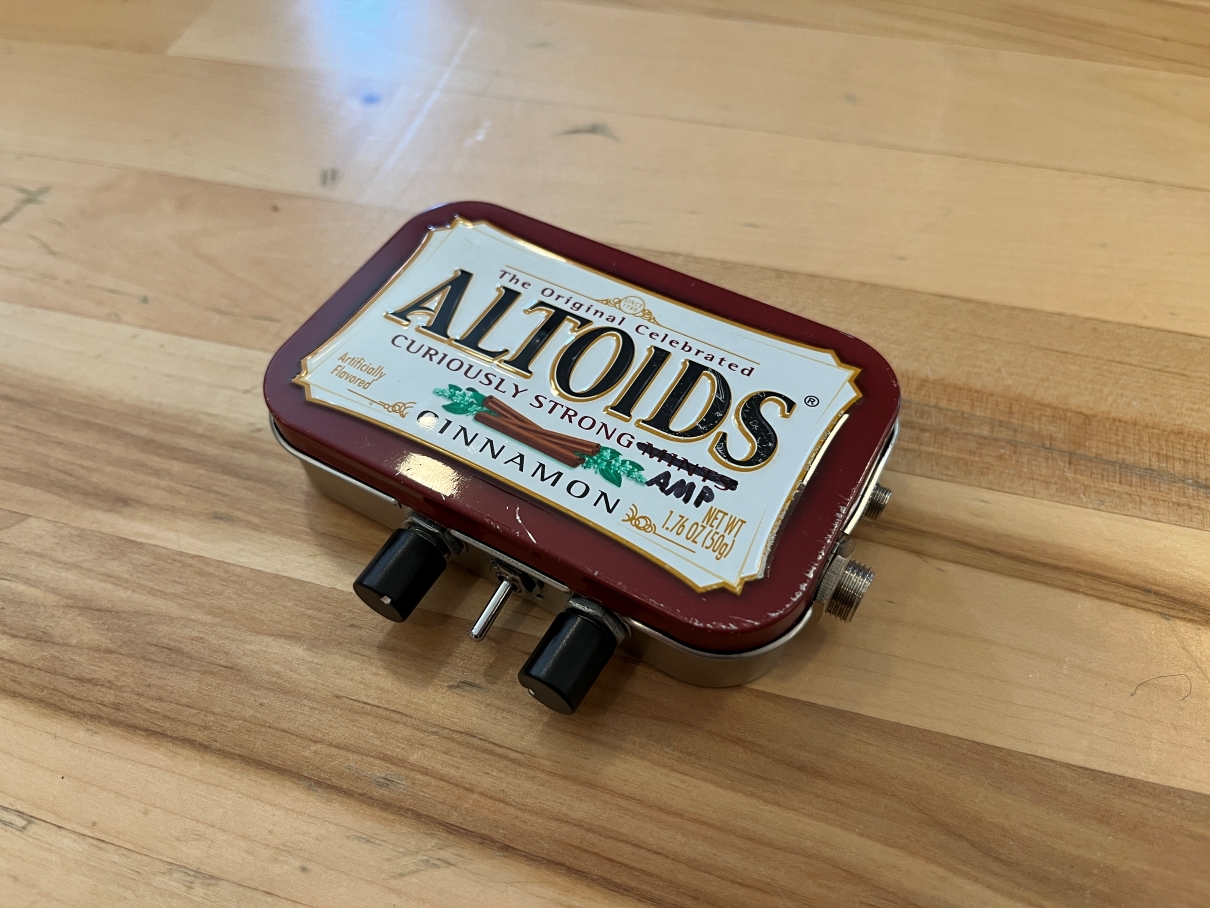
The Cinnamon Headphone Amp is built around the Ruby amplifier from runoffgroove. An analysis of this amp and its performance is available here I've modified it in the following ways:
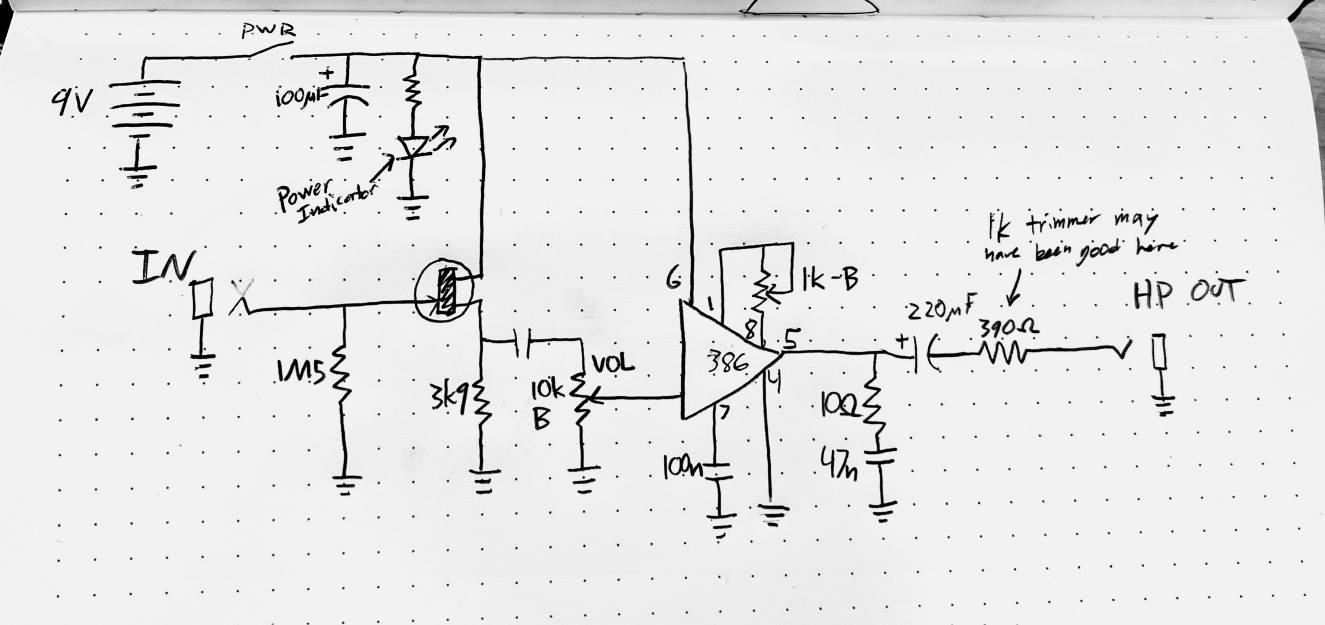
schematic
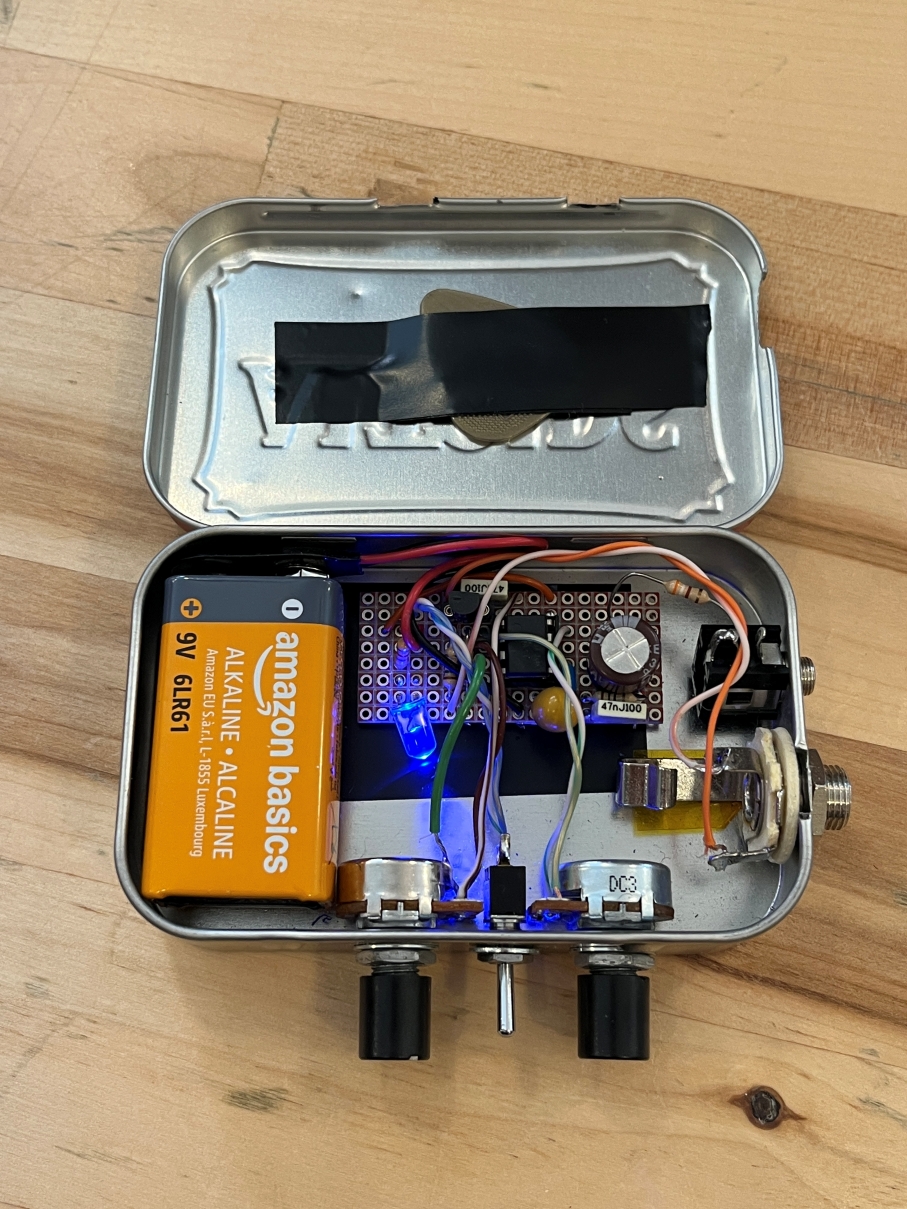
Jacks and pots were placed on the sides of the tin rather than the lid to prevent the knobs from getting caught on things if I threw this in a bag. The power switch was an afterthought, and it was placed between the pots because that was the only place I could put it. If I wanted to lie to you (which I would never do), I could say that nestling the power switch between the pots in this way was to prevent it from being turned on accidentally. In reality, this was an unintended good idea.
An unintended consequence of the power switch placement is that there wasn't enough room for the solder lugs on the pots. I had to clip them off and solder straight to the rivets. All of that stress on the rivets caused a couple of them to lose their connection to the traces in the pots. I ultimately fixed them by crimping the rivets tighter with a pair of needle-nose pliers.
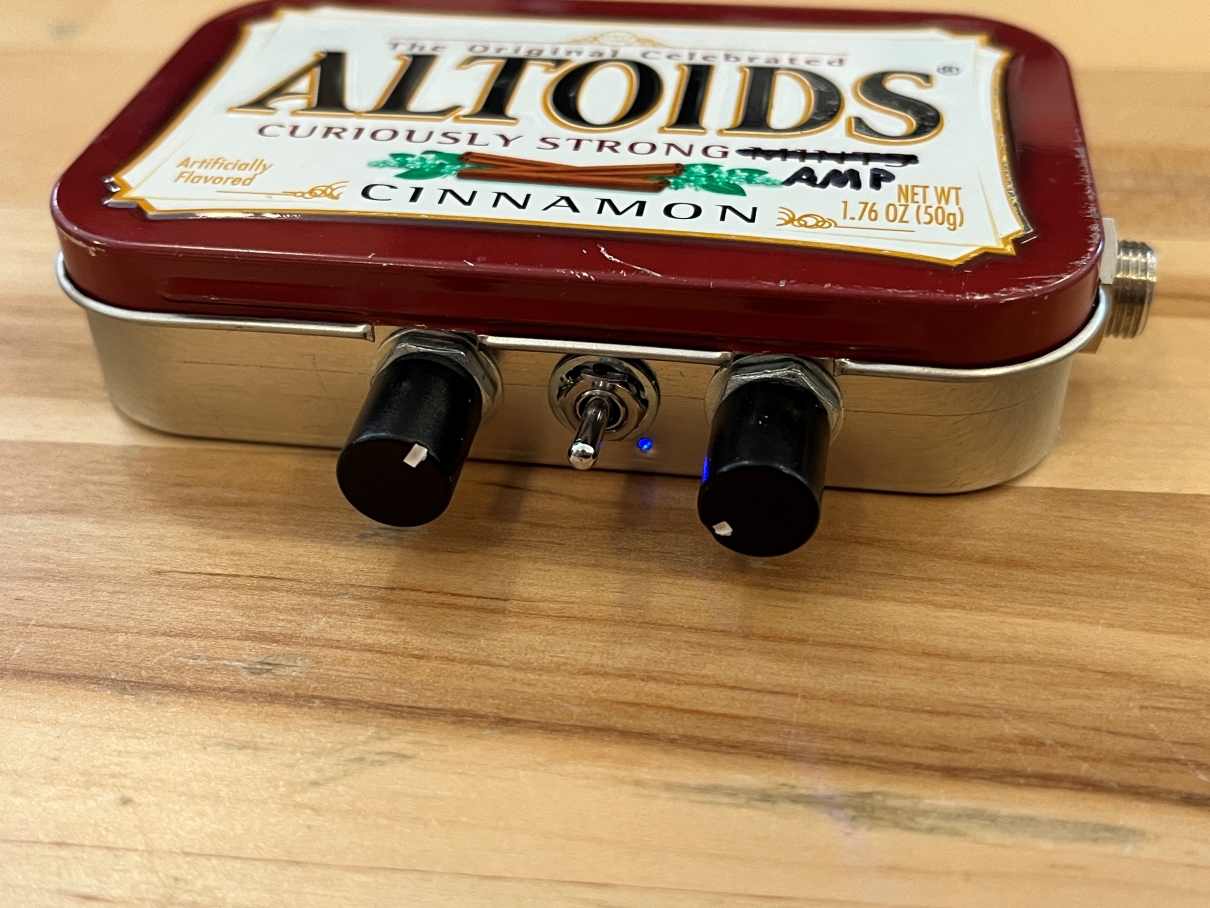
The power indicator LED was another afterthought. I opted to drill a very small hole in the tin right below the power switch and angle the LED to shine through that hole. It works pretty well. I was going to go with a vintage red LED just for the vibes, but those are so inefficient that I got worried about battery life. I opted instead for a modern blue LED. I forget what I went with for the resistor, but if I remember right it's only drawing a few mA.
There's very little clearance on the pots and jacks. The interior of an Altoids-style mint tin is only 20mm tall, and the mono jacks I have are 19.5mm or so in diameter. You can see that I had to remove a little bit of the rolled rim on the interior of the tin to make room for the components. I did that with a sheet metal nibbler, but it could have been done with a file. I suggest using a step drill when drilling holes in thin sheet metal like this. Better yet, a step drill and a tapered reamer. You'll also want a deburring tool of some sort.
Altoids tins are made of steel, which, though not as good as aluminum, conducts perfectly well enough for a small, low-powered project like this. You can see that I've only grounded the can of one pot and the sleeve of the input jack. I was going to ground the output jack sleeve, but I got lazy at that point.
The components I went with are just what I had lying around. One of the components I used has some microphonics, so if I ever remake this I might experiment with different caps or something to eliminate that. It's not a big deal though.
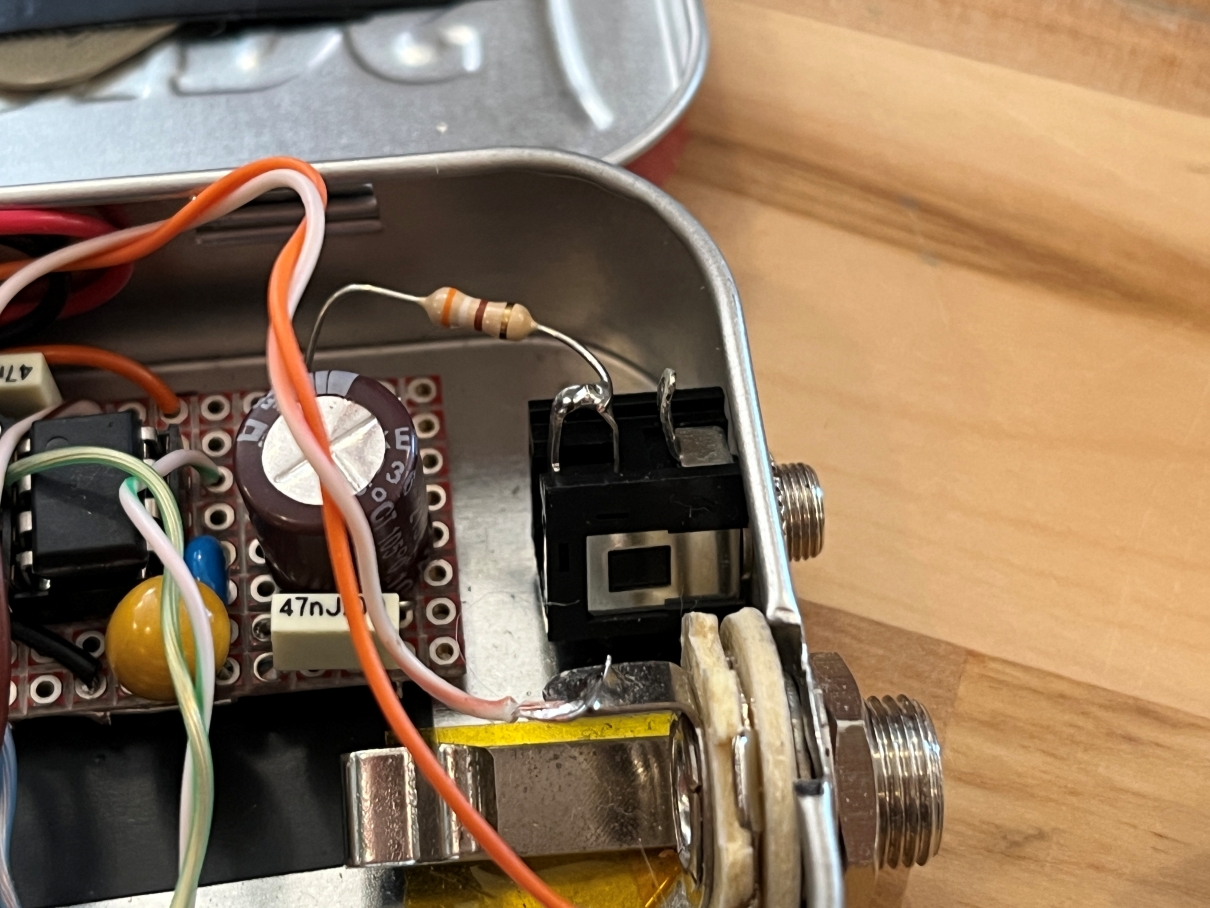
I had to solder the tip and ring together on the output to get audio to both ears.
I love this thing. Growing up, my first intruction to electronics was through my dad. He was a subscriber to MAKE Magazine and a big fan of Instructables.com, both of which were full of cheap DIY projects centered around repurposed materials. Altoids tins are a classic platform for little DIY projects, and I'm very happy to have created something of my own in that form factor.
If I had to do it all over again, I'd make these changes
Getting all of those changes made will probably require either smaller pots or a bigger enclosure. As you can see from the photos, I've got plenty of space in the middle, I just ran out of space on the edges.
That's all I feel like writing about this at the moment. I hope this inspires you to make something in a mint tin.